
Platform capability
Give every connected machine, gateway, meter, controller, and sensor a durable identity, a reusable data model, a place in the asset hierarchy, and a direct path to live and historical data.
Watch · 1:57 min
From the first connection to live data. Controllers, building systems, and sensors connected over their own protocols, devices found by a BACnet scan, each device type described once in a profile, every device in its place in the hierarchy, and every value stored with its device and profile.
01Device registry
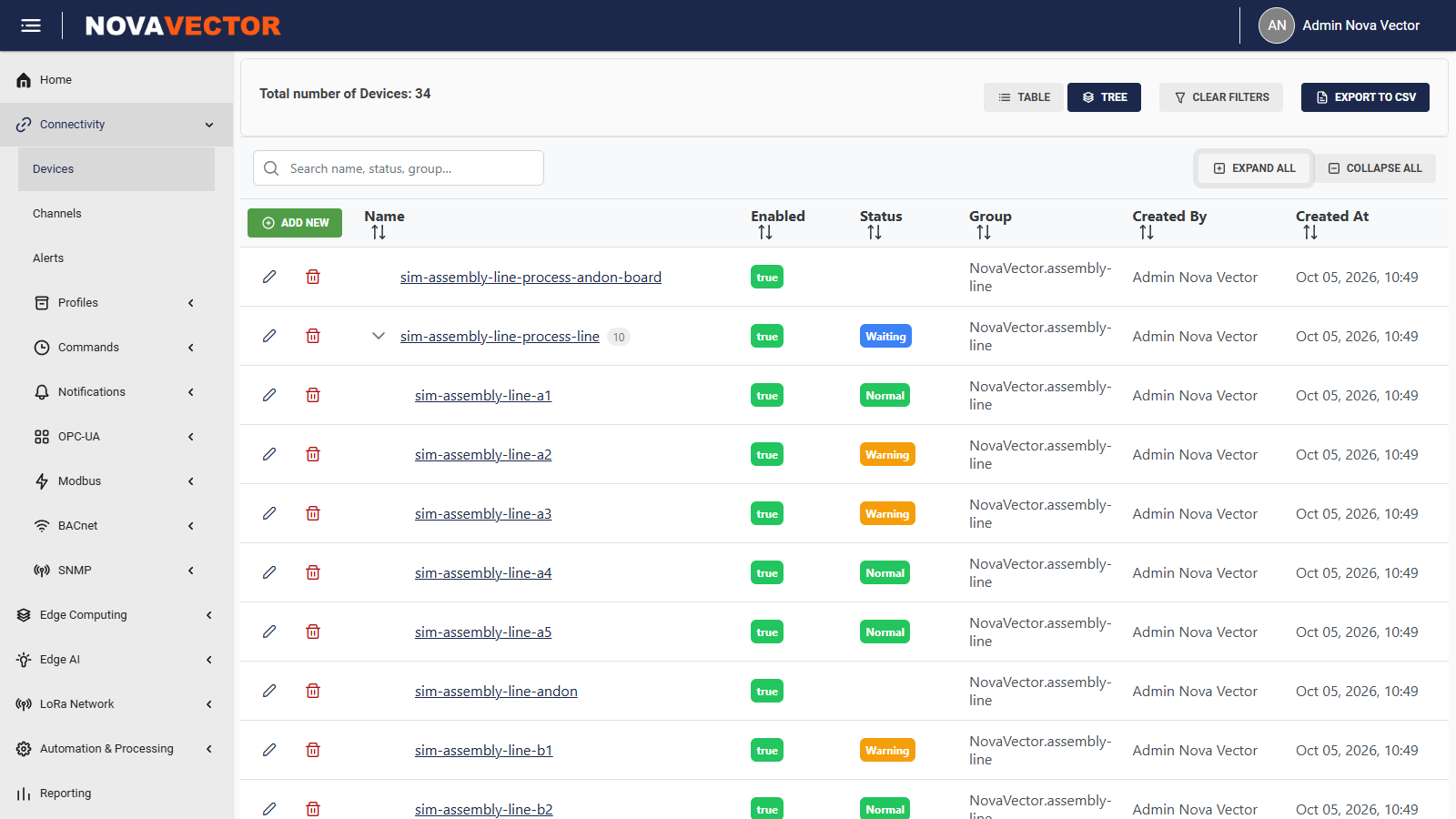
Nova Vector does not treat connected equipment as an anonymous stream of measurements. Each device is registered with an identity, ownership group, status, profile, metadata, and parent relationship, so the platform can represent sites, areas, lines, machines, gateways, meters, sensors, and other assets in a practical hierarchy.
That structure becomes the operating context for everything that follows. Live data, alerts, tasks, production records, reports, and integration logic all refer back to the same registered equipment instead of keeping parallel naming schemes in different applications.
02Industrial connectivity
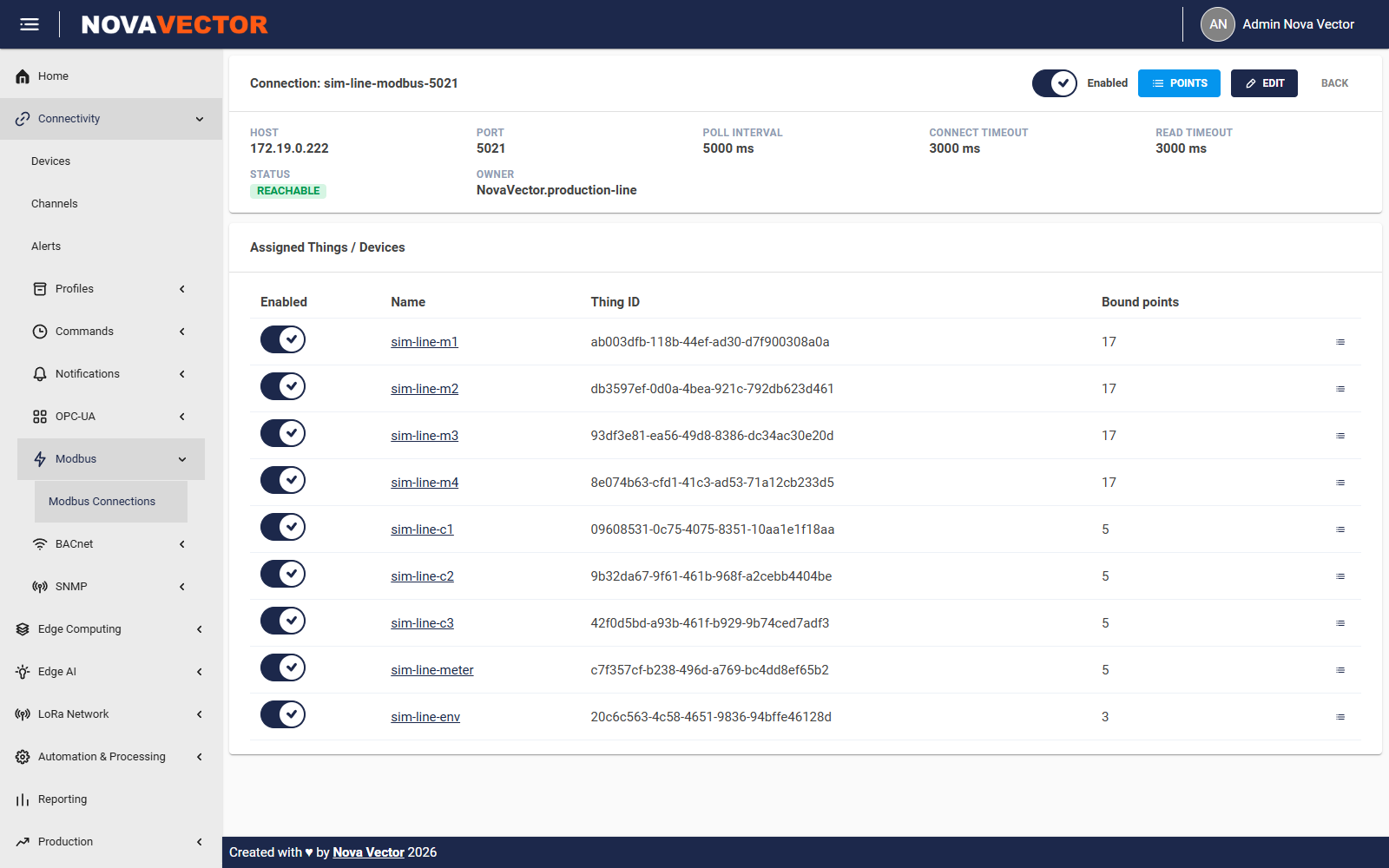
Nova Vector reads industrial controllers and building systems directly over OPC UA, Modbus TCP, BACnet/IP, and SNMP traps, and accepts data from IoT devices over MQTT, HTTP, and WebSocket. Long-range, low-power sensors connect through LoRaWAN, which is in production use in smart agriculture. CoAP is in pilot.
One connection serves every device behind a gateway or controller, and each connection can be switched on or off on its own. Edge nodes add further device protocols through EdgeX Foundry where equipment cannot reach the platform directly.
03Legacy equipment
Machines without a readable controller do not have to be replaced. They can be retrofitted with sensors that deliver the same data set as modern equipment, such as machine state, counts, and energy, without major investment or production downtime.
Once connected, a retrofitted machine uses the same profiles, dashboards, alerts, and reports as the rest of the line, so older and newer equipment can be compared on equal terms.
04Discovery and binding
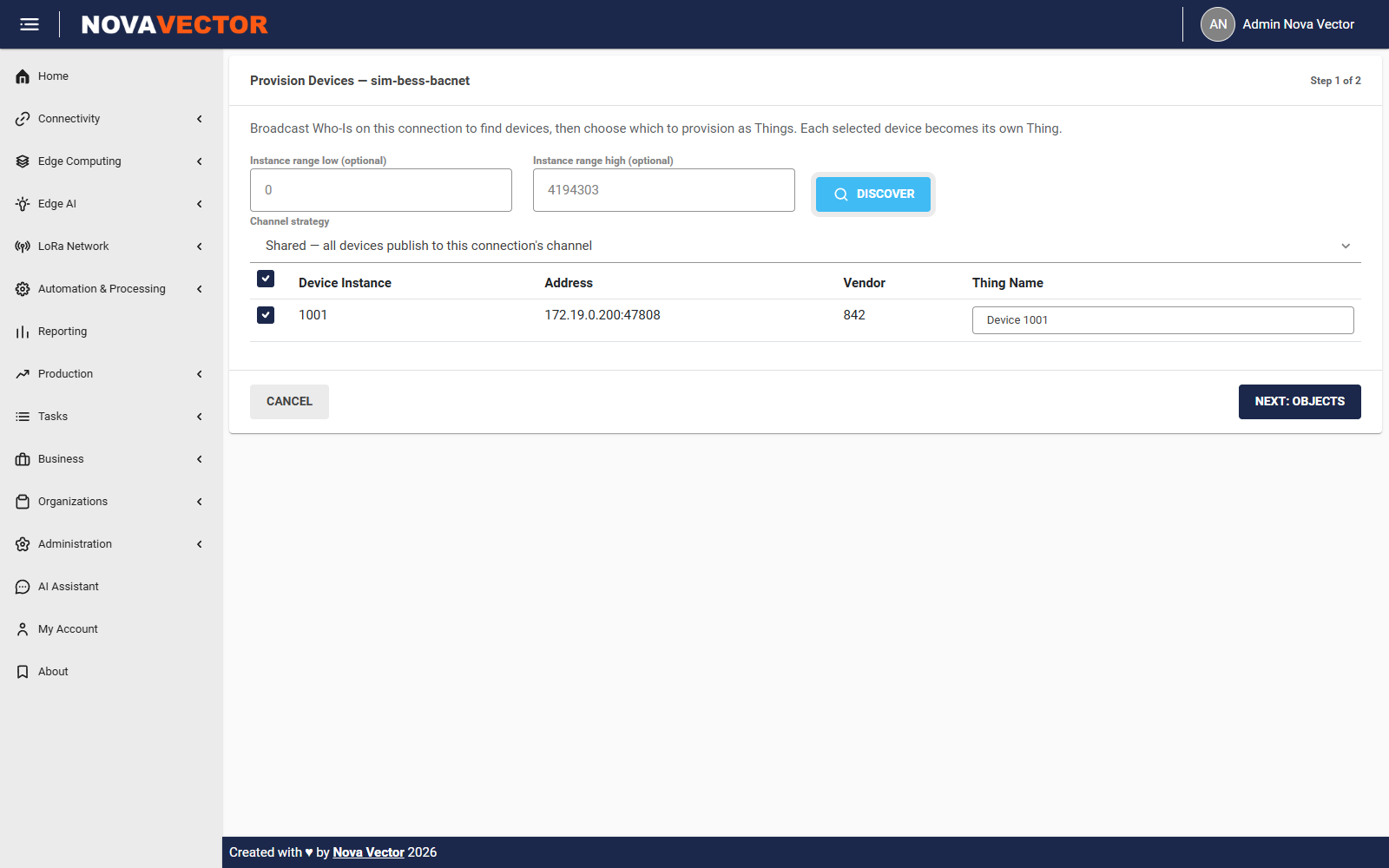
A BACnet Who-Is broadcast finds the devices on the network, and the platform reads each device's object list with names and live values. Selected objects can be bound in bulk, with a poll rate and optional publish-on-change. OPC UA servers can be browsed and subscribed to; Modbus register maps live in the device profile.
Report by exception keeps traffic and storage low. Modbus and BACnet values can be sent only when they change by more than a set deadband, with a maximum interval as a heartbeat; OPC UA applies its deadband at the server.
05Reusable profiles
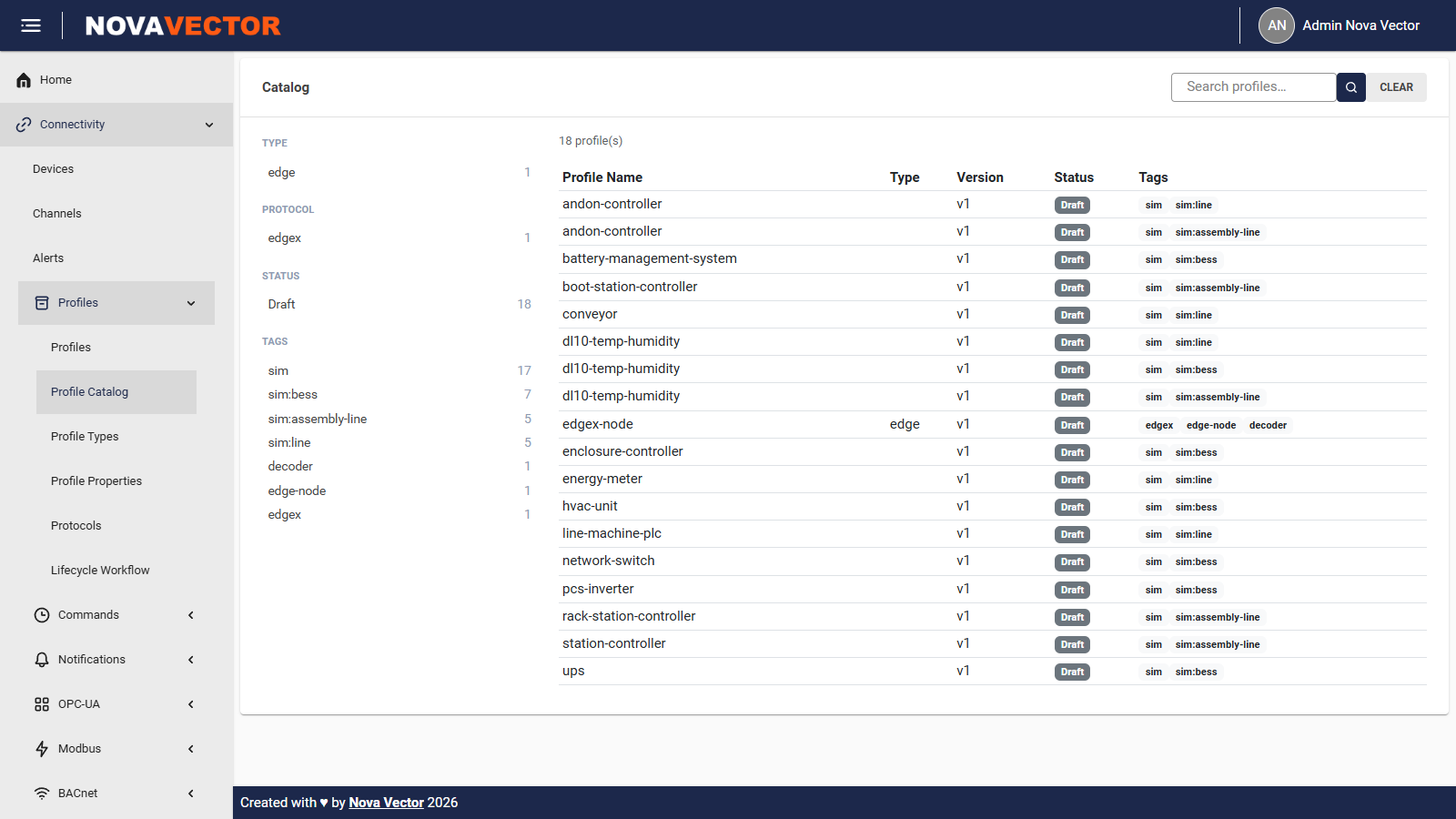
Device profiles define the measurements and properties that give raw protocol data meaning. A profile can describe metric names, engineering units, data types, ranges, protocol registers or objects, report-by-exception defaults, custom properties, and payload-decoding logic.
Profiles are versioned, move through lifecycle states, and can be exported or imported. That makes them useful for repeated deployments of the same meter, PLC interface, machine family, or gateway without rebuilding the data model for every instance.
06Live and historical data
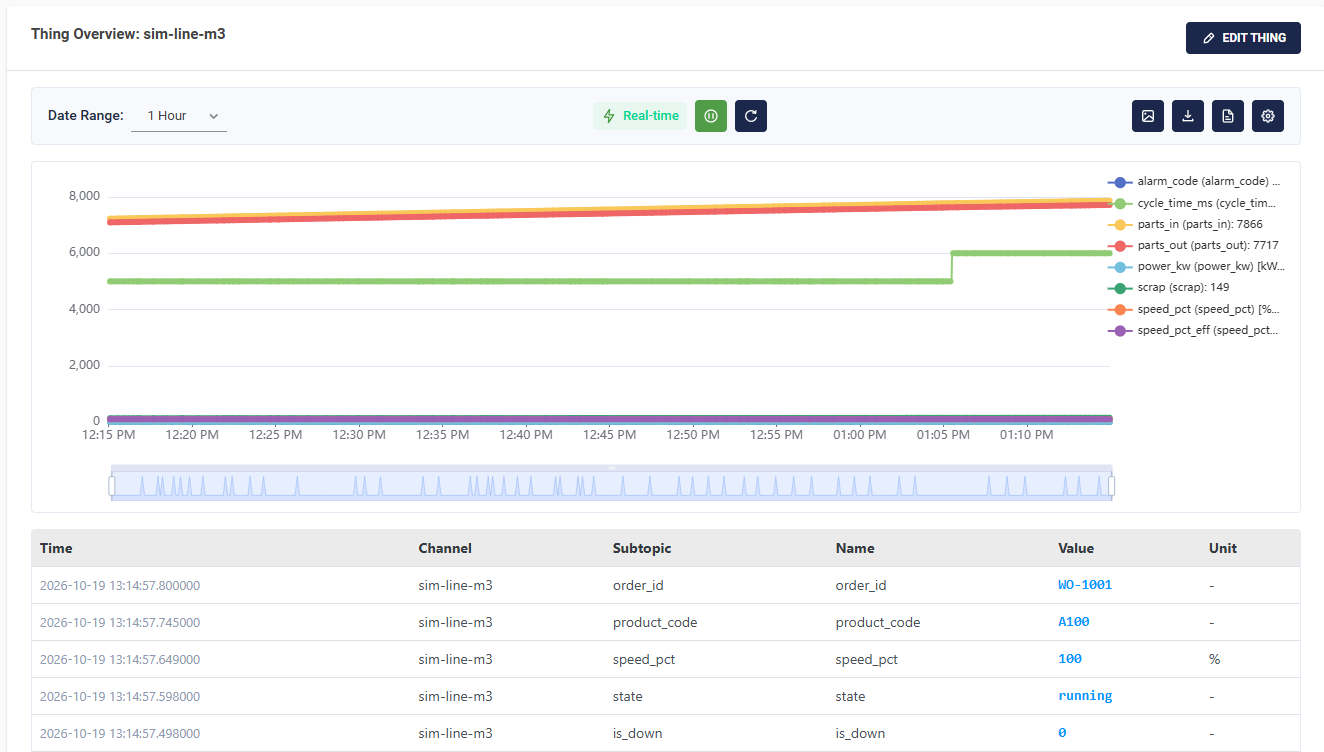
Each device has its own page with identity, configuration, a live chart of every value it sends, and each reading as it arrives. Users can filter by metric, adjust the time window, and open richer Grafana-based views when deeper analysis is needed.
Historical readings are stored as time series and remain available to reports, the data API, process replay, and CSV export, without losing the equipment and profile context that explains what each signal represents.
Continue evaluating
Discuss your architecture