
Industrial solution
Off-the-shelf LoRaWAN sensors report soil and weather conditions from the field. Machinery joins through its controllers. Nova Vector learns what is normal, raises the problems, and tracks how the team responds.
01Weather in the field
LoRaWAN weather stations measure air temperature, humidity, rainfall, wind, and solar radiation where the crops grow, not at the nearest town. Long-range, low-power radio covers large fields and remote plots from a few gateways, and battery-powered stations keep reporting without cabling or mains power.
The LoRaWAN network server is bundled with the platform. It has run in production for more than three years in a smart-agriculture deployment, with sensors reporting from the ground through every season.

02Soil
Soil probes report moisture and temperature at one or more depths, together with electrical conductivity (EC), pH, and nitrogen, phosphorus, and potassium (NPK). Readings arrive every few minutes instead of from a laboratory sample taken a few times a year.
Choose sensors from established LoRaWAN vendors; no proprietary hardware is needed. Each sensor model gets its payload decoder once, in its device profile, from a template or written for the vendor's format and tested with a sample payload. Every sensor of that model then uses it, and messages that cannot be decoded are kept apart instead of mixed into the data.
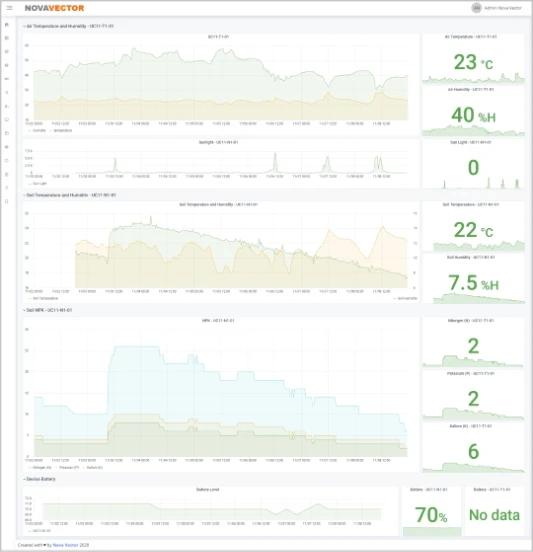
03Machinery
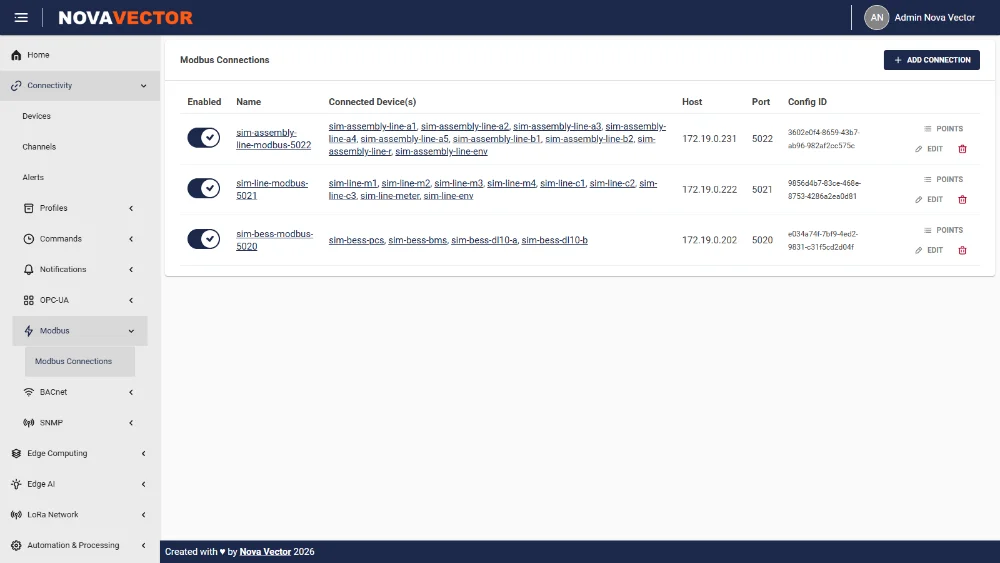
Irrigation pumps, generators, cold stores, dryers, and other equipment with a controller connect over Modbus TCP or OPC UA. Machines without a readable controller can be retrofitted with sensors, for example power meters or LoRaWAN sensors, so they report too.
An edge node at the farm reads local controllers next to the equipment and keeps reading when the connection to the platform drops. Readings from controllers become states such as running, stopped, or fault, so the team sees which machine needs attention, not only a list of numbers.
04Anomaly detection
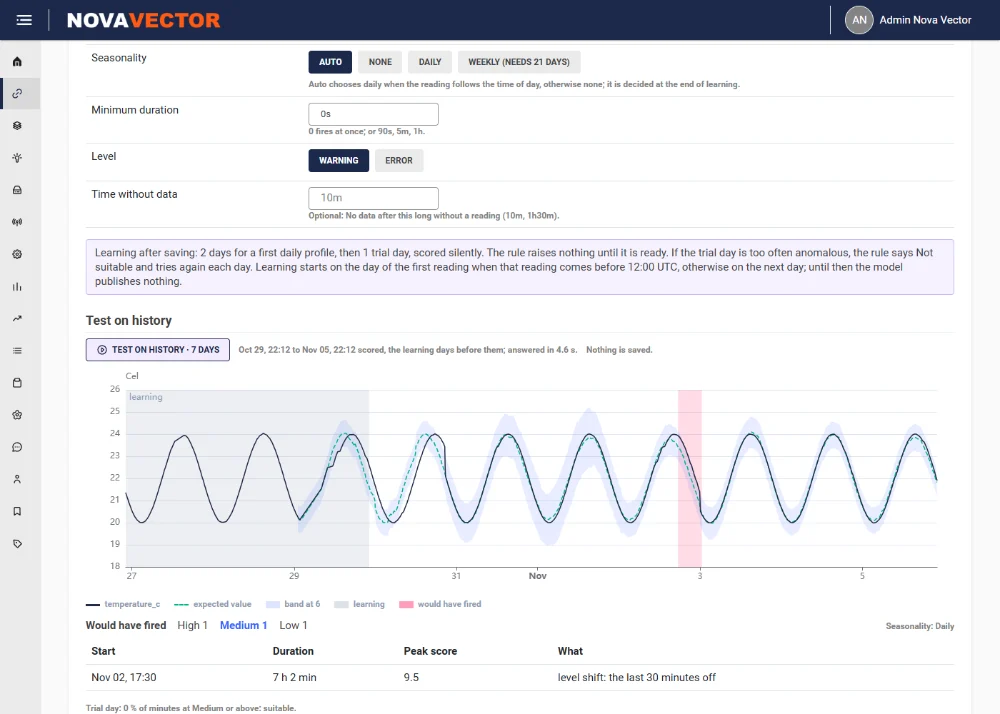
An anomaly rule learns what is normal for one reading of one sensor, its level, its daily rhythm, and its noise, and raises an alarm when the reading leaves that. It catches a soil probe that stops changing, a weather station that turns noisy, or a pump that draws more power than it usually does, without anyone choosing a threshold first.
Before a rule is saved, it runs over the last seven days of history, showing where it would have fired. Fixed limits and no-data checks are available beside it for the conditions the agronomist already knows, such as frost risk or a sensor that went silent.
05Tasks
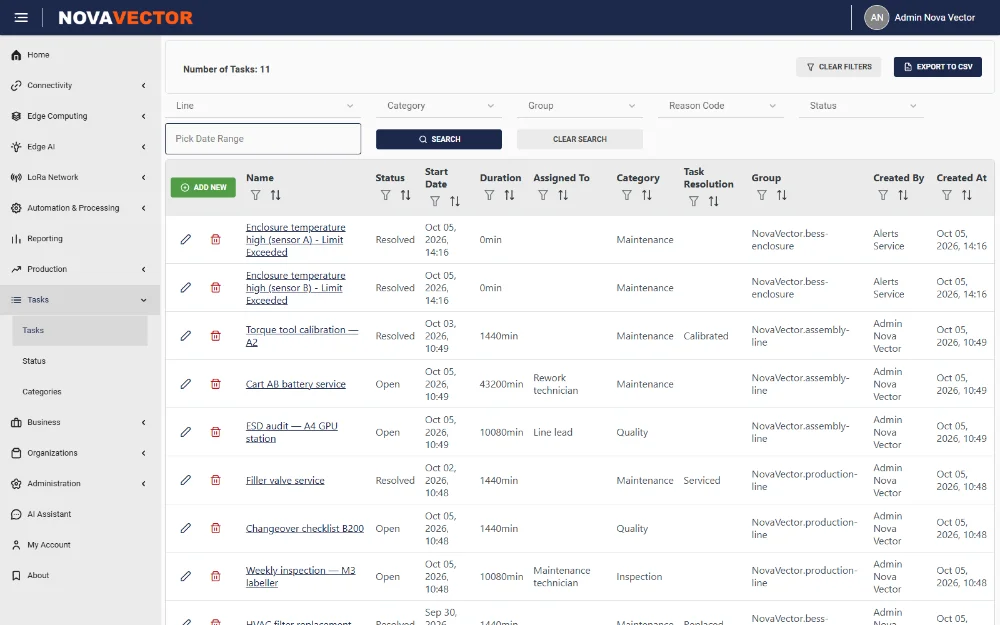
An alarm can open a task automatically, with its category, its group, and the sensor and reading that caused it. The task closes itself when the condition clears, and e-mail notifications reach the people who need to know.
Routine field work runs the same way. Templates and schedules create recurring tasks, such as checking sensors, cleaning a rain gauge, or servicing a pump, and boards show the open work of every team.
06People
Acknowledging an alarm records who did it, when, why, and with what comment. A task's history shows who took it, every status change, and the time logged on it, so every response can be traced from the alarm to the fix.
Team reports show how quickly people respond and resolve problems, what is open or overdue for each person, and how the workload is shared, so managers can see where the farm needs more hands or better routines.
07Integration
Every module has a documented REST API, and applications can exchange data over MQTT or HTTPS with their own credentials. Readings and aggregates for any period are available through the data API, and reports export to CSV and PDF.
Farm management, ERP, and weather-service integrations are built for each project by the team that develops the platform, using your own data model, so that field data, work orders, and records stay consistent.
Continue evaluating
Questions
Off-the-shelf sensors from any vendor whose payload format is documented. The decoder for each sensor model is set up once in its device profile and tested with a sample payload before the sensors go into the field.
The LoRaWAN network server is bundled with the platform. The farm needs LoRaWAN gateways with coverage over its fields; they are registered in the network server. The EU868 band is configured by default.
Commands can be sent to controllers and MQTT devices, set up for each project. Sending commands down to LoRaWAN devices is not supported today.
No. Anomaly rules learn what is normal for each reading. Fixed limits and no-data checks are available for the conditions you already know.
Discuss your architecture