
Technical evaluation
See how one Nova Vector installation connects field equipment, edge nodes, platform services, users, APIs, and operational applications—and where project-specific architecture decisions are still required.
01High-level architecture
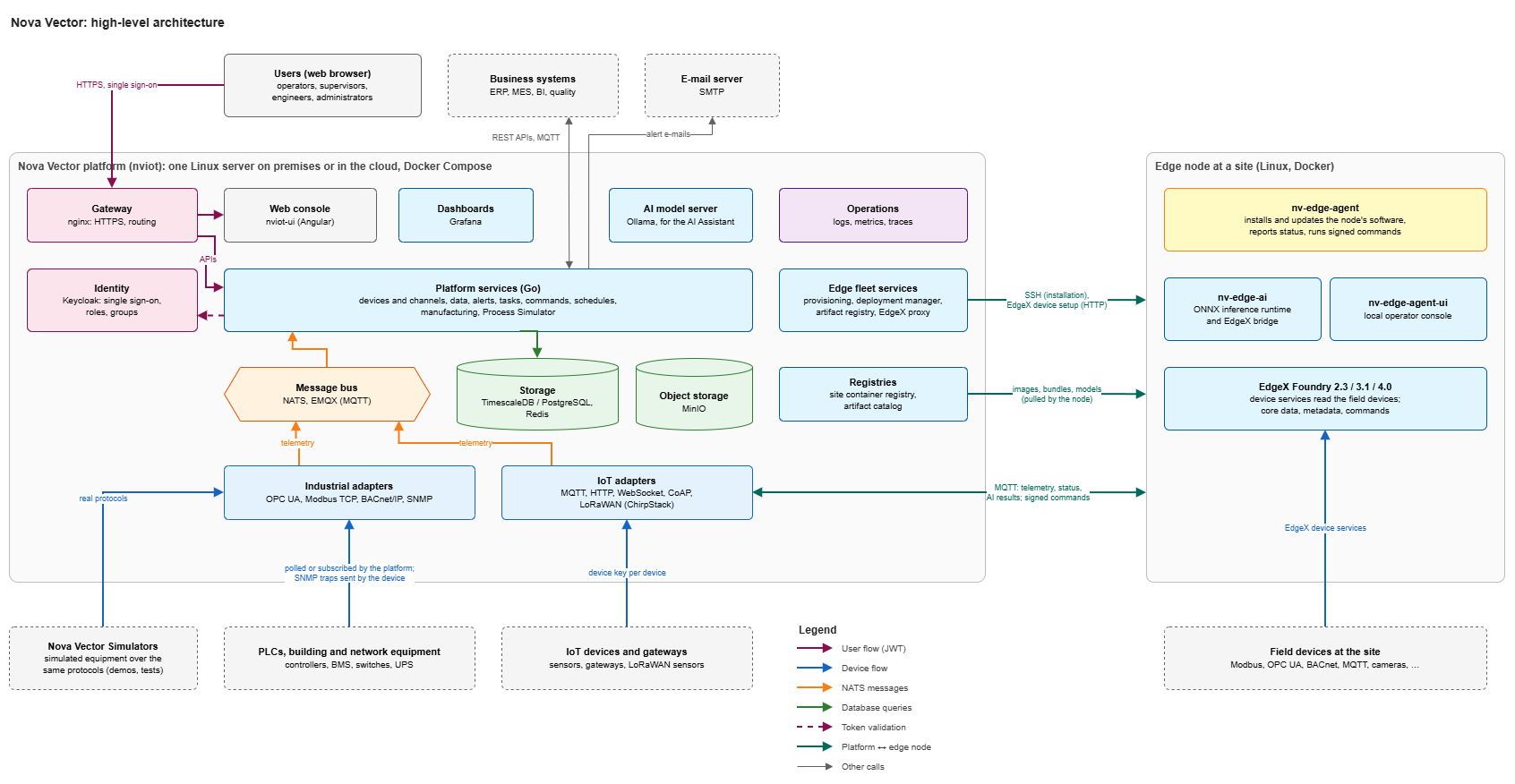
The standard platform installation runs as Docker containers on one x86-64 Linux server, either on premises or in a customer-controlled cloud environment. It holds the device registry, stored data, alerts, tasks, manufacturing records, web console, and services used to manage edge nodes.
Edge nodes, typically an industrial PC next to the equipment, can host the Nova Vector Edge Agent, EdgeX Foundry services, the Edge AI runtime, and a local operator console. IoT devices can send data to the platform, while industrial adapters can connect outward to controllers, building systems, and network equipment.
02Platform building blocks
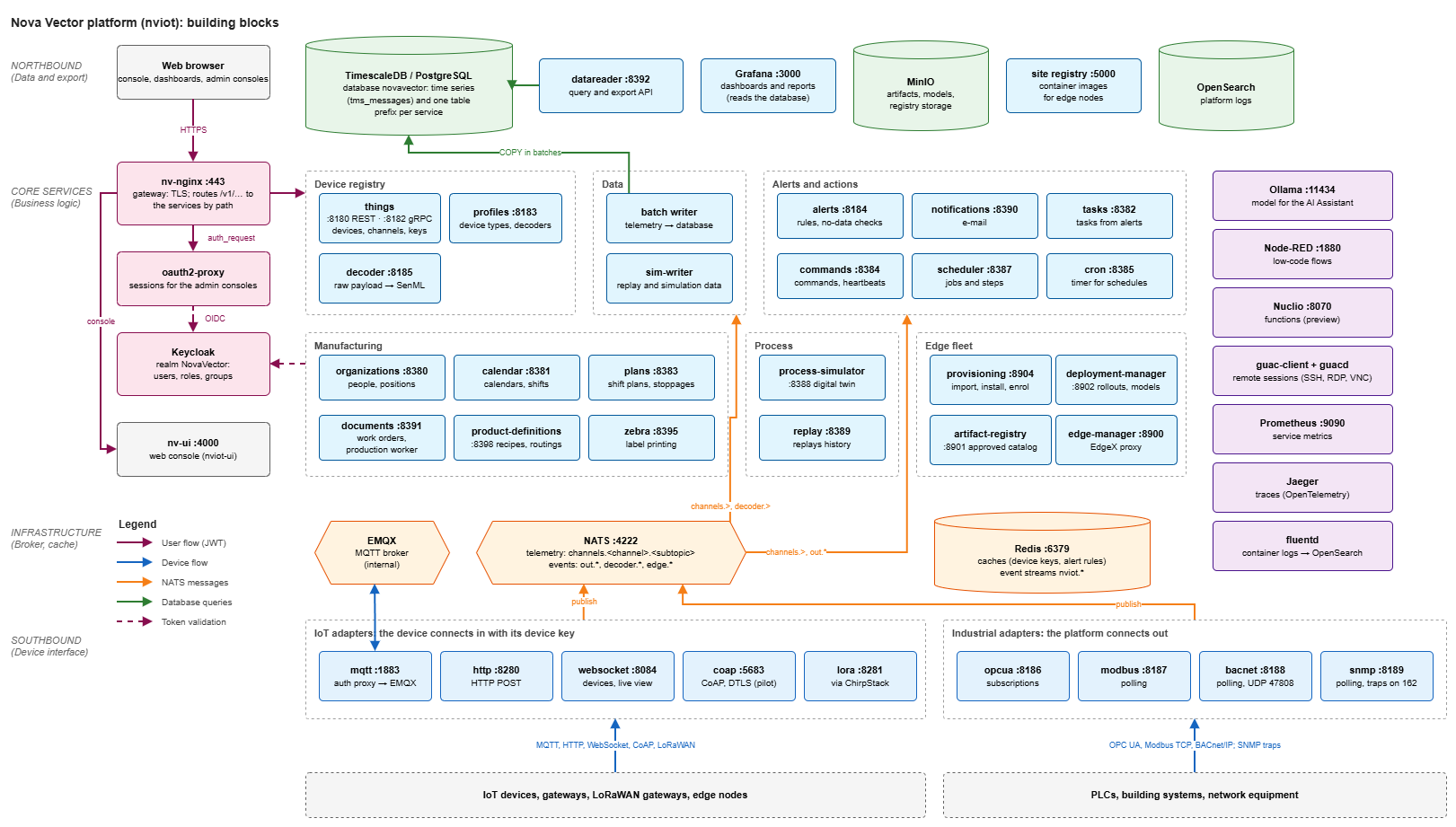
The platform uses nginx as the web entry point, Keycloak for user identity, protocol adapters at the device boundary, NATS and Redis for internal messaging patterns, PostgreSQL and TimescaleDB for operational and time-series data, and object storage for approved artifacts.
Operational modules—including alerts, tasks, manufacturing, reports, process simulation, edge management, AI, dashboards, automation, and APIs—share the same device, channel, identity, and event foundation without being collapsed into one application.
03Telemetry path
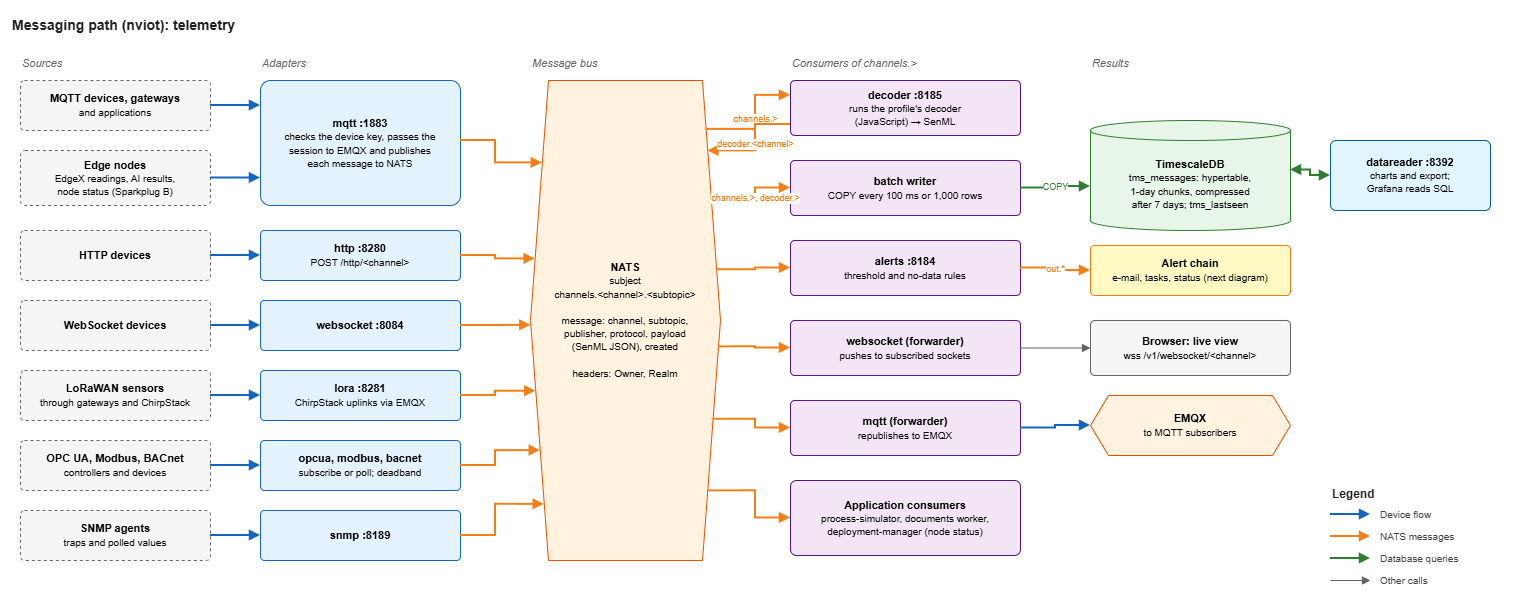
Device and adapter traffic enters through the supported protocol path, is normalized into the platform reading format, distributed to interested services, and written to time-series storage.
Device profiles can decode vendor payloads into normalized readings for storage and visualization. Current architecture documentation distinguishes these decoded readings from the original readings used by the alert engine.
04Events and commands
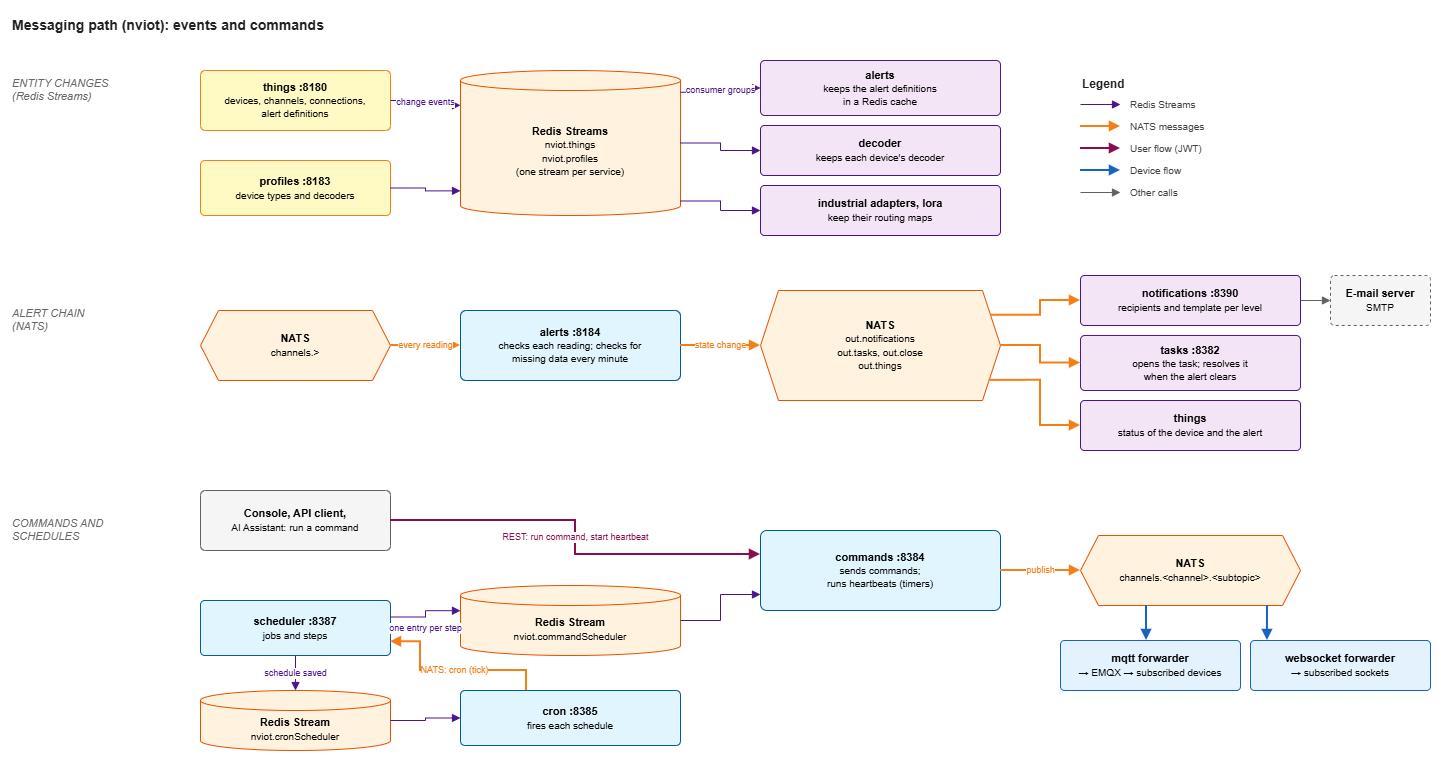
Record changes are distributed through Redis Streams to services that maintain their own operational copy. Alert outcomes and device commands travel through NATS, while scheduled jobs and heartbeats feed the same command path.
Edge nodes use their MQTT control channel for status and signed deployment commands. A command request is observable as a software operation; network and physical device execution remain separate concerns.
05Device authentication
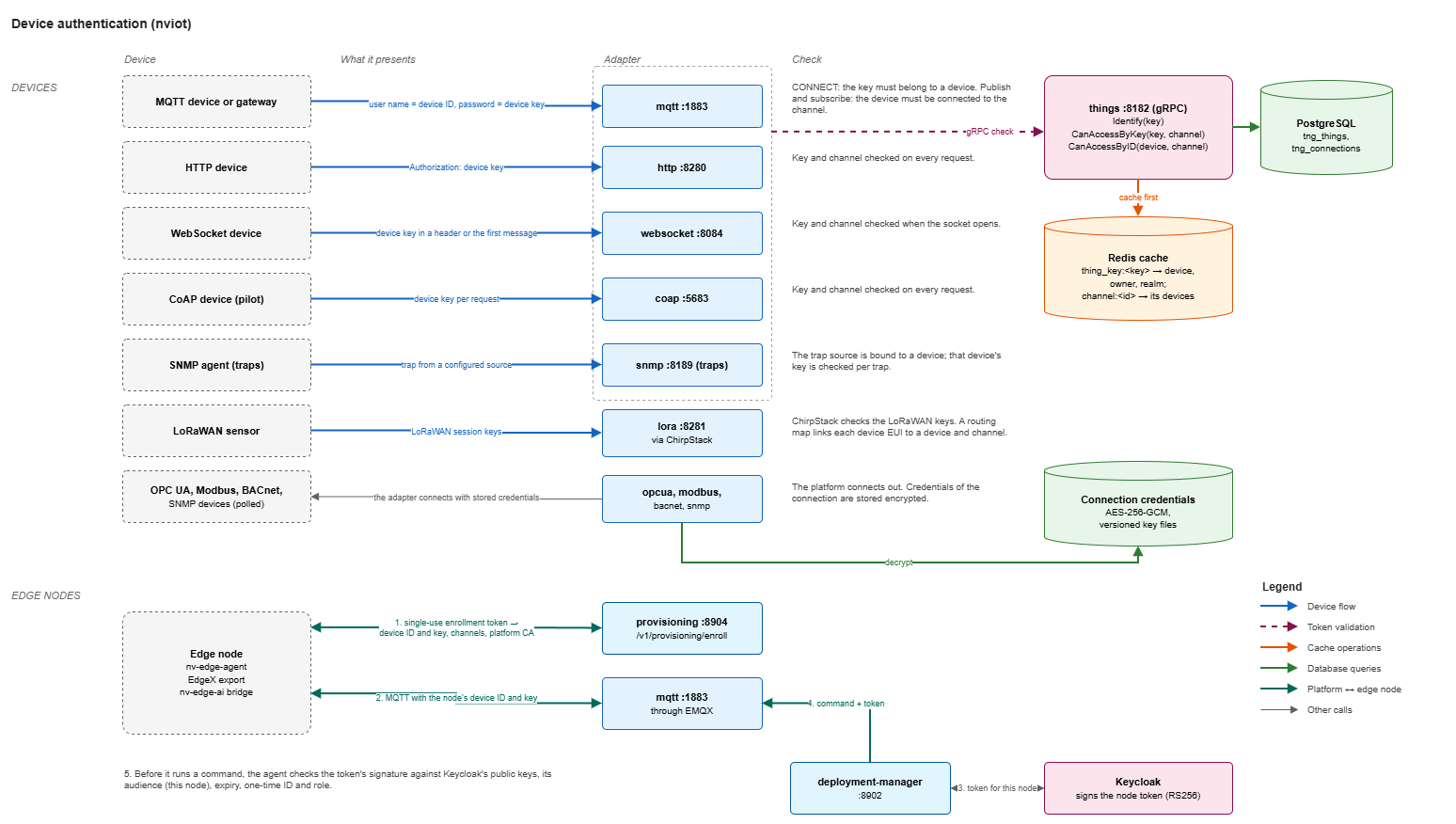
Device identity and connection checks depend on the selected protocol and adapter. Edge nodes use their registered device identity for telemetry and status, while edge-management commands carry signed command tokens.
Transport security is finalized per deployment. MQTT over TLS is available, but the standard installation does not publish it by default.
06User authentication
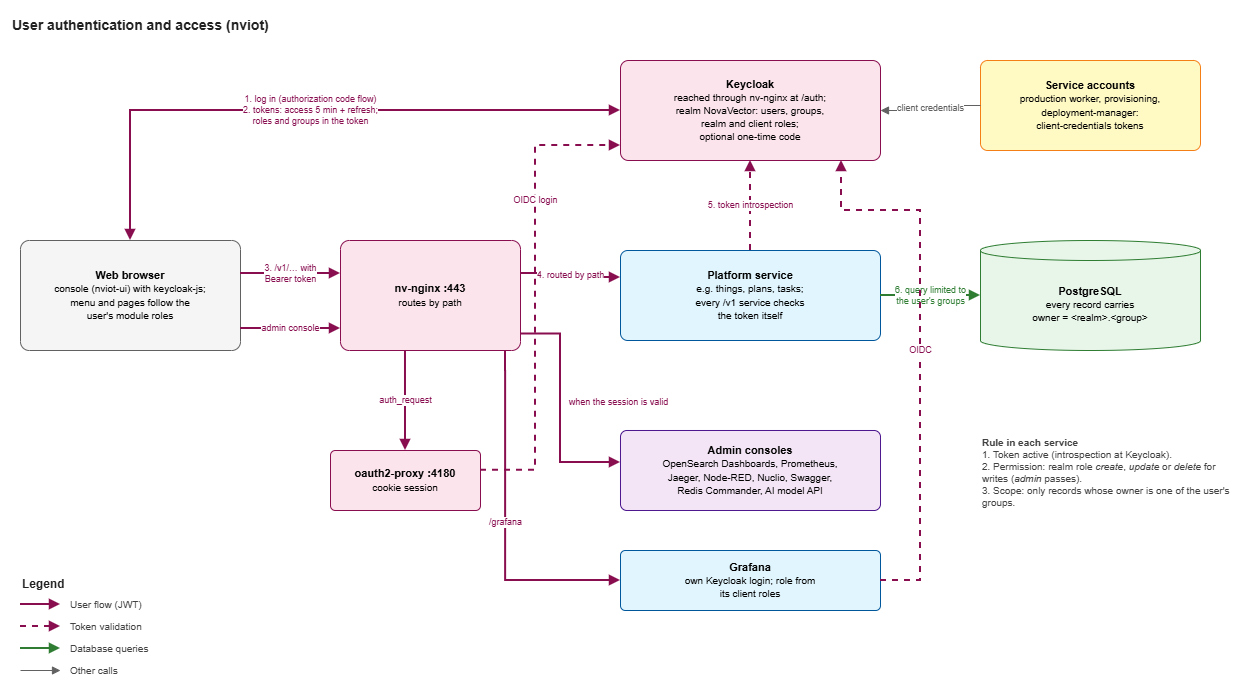
Users sign in through Keycloak. Platform services validate the active token and use roles, permissions, and group ownership to control access to records and modules.
Two-factor authentication is available but is not enforced by default. Company-directory integration, password policy, audit requirements, and administration-console restrictions are finalized for each production project.
07Current deployment scope
The standard Docker Compose installation runs one instance of each service on one server. Industrial adapters and the batch writer can scale independently, but a fully redundant installation is designed per project.
Kubernetes is delivered as a project service; standard whole-platform manifests or Helm charts are not shipped today. Isolated networks are prepared per project rather than through a packaged offline installer.
Continue evaluating
Discuss your architecture